CreativeGate is a simulation-first evaluation funnel for digital creative artifacts. Given a creative (ad copy, caption, image) and a ground-truth set of artifacts with known real-world outcomes, it answers a single question: how likely is this to work on real users — with what confidence, according to which validated evaluators, and what is the cheapest next test that would raise that confidence?
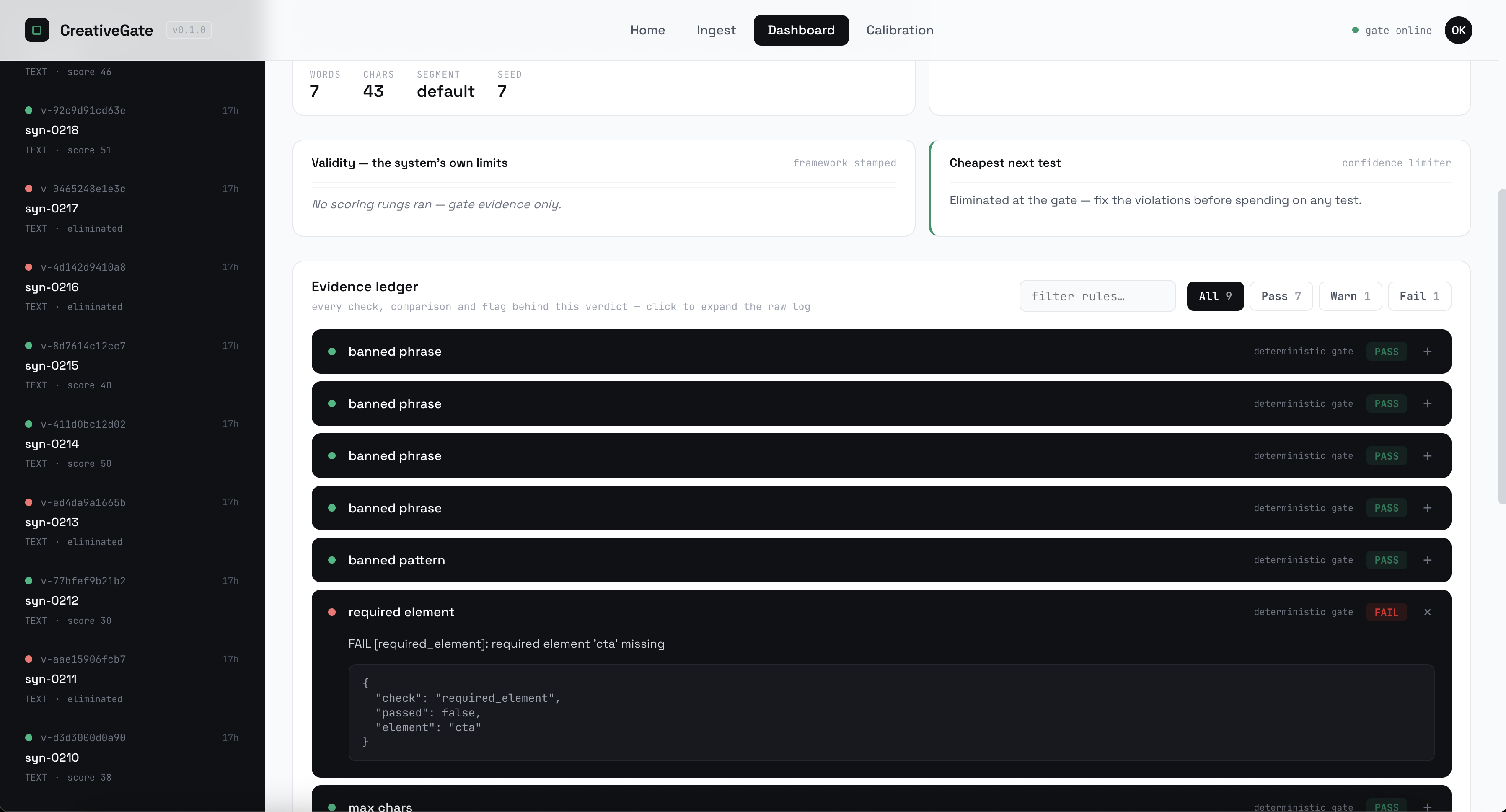
The metaphor is a wind tunnel. Most digital creative skips instrumented testing and goes from generation straight to spend. CreativeGate is the wind tunnel — plus the discipline that keeps one honest. Artifacts fall through three escalating rungs: a free deterministic gate (banned claims, required CTA, structural specs), a cheap performance predictor (a GBM ensemble over engineered + embedding features), and a moderate calibrated judge ensemble (pairwise A/B against known-outcome anchors). Survivors are fused into a single score with a confidence band — never a bare point score — plus an evidence ledger for every decision and a cheapest-next-test recommendation.
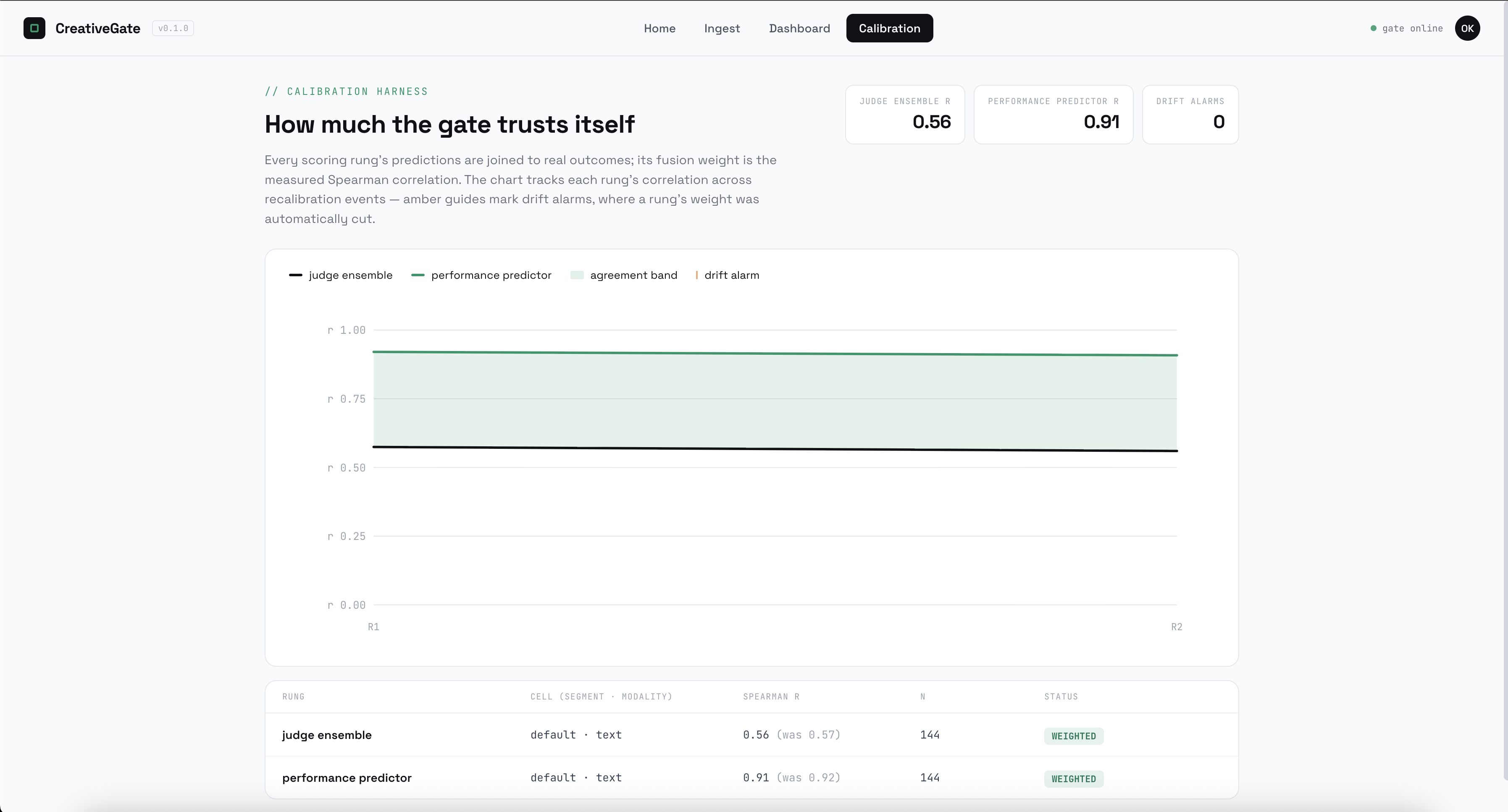
The differentiator is the calibration harness: when real outcomes arrive, it joins predictions to reality, recomputes per-rung correlation, and raises a drift alarm that automatically cuts a decaying rung’s weight. Safety rails are encoded as the spine of the test suite — an uncalibrated rung can never carry fusion weight, and no rung can report validity it hasn’t earned. Models are enhancers, never dependencies: with zero API keys the judge falls back to a deterministic comparator and the predictor to TF-IDF embeddings, both clearly labeled degraded fidelity. Ships with a Dockerfile and Railway config as a single always-on service.